.. Rule Reuse
 TL;DR - Rules are not per path
Requirements often name one path: "on moving an order to a different customer, check credit." With procedural code, each path needs its own code. With rules, it is usually already done: the rules are declared on the data, so they run on every write path, automatically.
This sample shows the AI recognizing that. Given a requirement that restates existing rules for one path, it adds no new rule: it links the requirement to the rules it uses, tests the path, and the traceability report shows the requirement as covered by existing rules.
Build It
Paste this into your AI assistant, from the Manager:
Then, in the created project: create tests, run the tests, and run the requirements traceability report.
The prompt is Check Credit and a Kafka publish (as in the basic demo), plus one requirement for a single path:
On Moving Orders to a different Customer, Check Credit
    1. Recompute the customers balances as the sum of the unshipped order totals
    2. The Customer's balance must not exceed the credit limit
What You Get
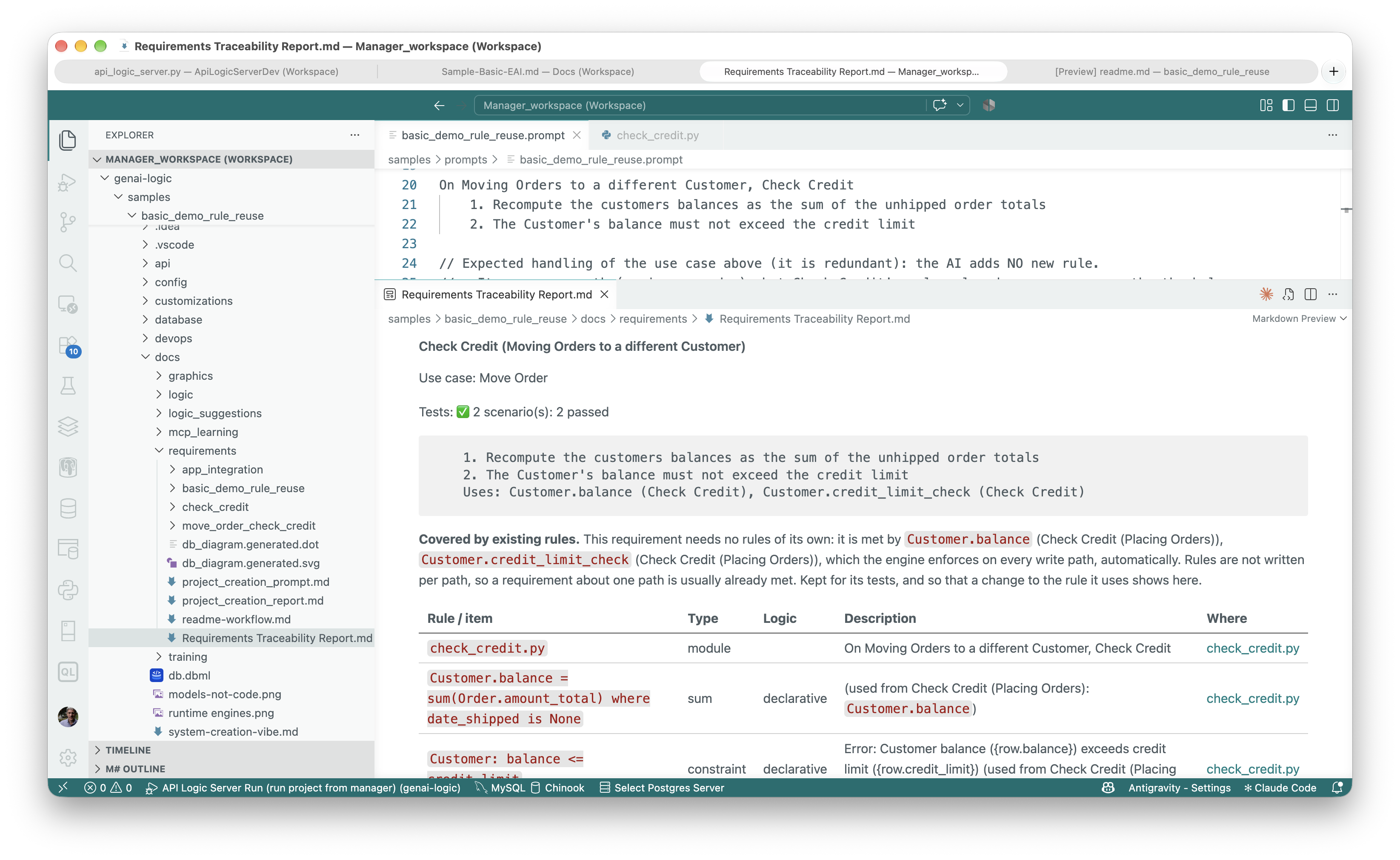
Check Credit's rules already cover moving an order: the balance sum adjusts both the old and the new customer, and the credit check runs on both. So for this requirement the AI:
- Adds no rule. A second constraint would run twice; a second derivation would stop the server.
- Links the requirement to the rules it uses, by name:
Uses: Customer.balance (Check Credit), Customer.credit_limit_check (Check Credit). - Writes a placeholder logic file,
logic/logic_discovery/move_order/check_credit.py: the requirement as its docstring, no rules, and theUses:line. A laterimplement reqsfinds it and adds nothing. - Notes it in
ad-libs.mdas redundant, with the test to write.
When you create tests, that path gets its own scenarios (a move within the limit adjusts both balances; a move over the limit is rejected). The report shows the requirement covered by existing rules, tested, and still listed, so a change to the rules it uses shows there too.
Rule Names
Requirements refer to rules by name (LogicBank 1.34.06):
- Derivations are named by the column they derive:
Customer.balance. - Constraints and events get a name when declared (
name="credit_limit_check"), so they readCustomer.credit_limit_checkandOrder.shipping_publish. The name appears in the logic log:Constraint Failure (Customer.credit_limit_check): ....
A Uses: name that matches no rule is flagged in the report, with the closest names (for example,
did you mean Customer.credit_limit_check?).