.. Students & Courses
 TL;DR - When the CE correctly refuses to guess, and what resolving it later looks like
students_courses— a course-attendance requirement with two traps a literal reading won't reveal: a column namedconsecutive_absenceswhose own requirement text sayscount(...)(a plain count never resets — it needs a streak, not a tally), and a Course Drop-Off Alert that depends on anAttendance(status='absent')row that nothing in the system ever writes. The CE catches both unaided: the streak gets built correctly, and the alert logic is left commented out with aFIXMErather than guessing a trigger mechanism it was never asked to invent.students_courses_1— the same project, carried one phase further. A second Executable Requirements pass supplies the missing design decision (an externally triggered sweep endpoint, suited to a clustered deployment, plus anEnrollmenttable the sweep needs to know who was expected) and turns theFIXMEinto working code.
Students & Courses
A two-phase example of the Executable Requirements workflow: the first phase shows the CE correctly identifying that a requirement depends on a design decision it hasn't been given, and the second phase shows what happens once that decision arrives.
Business rules fire on a write. If you need to find out that nothing happened, rules are not a direct solution — but they can help, once something outside the rules supplies the missing row.
Phase 1 — students_courses: correctly blocked
This was a deliberate stress test: the requirement was written without saying how absences are detected, to check that the AI does not act presumptuously.
1. Enrollment Capacity:
   - Course.enrolled_count = count(Attendance where status in ('attended', 'excused'))
   - Course.enrolled_count <= Course.max_capacity
2. Absence Tracking:
   - Student.consecutive_absences = count(Attendance where status == 'absent')
   - Student.total_sessions_completed = count(Attendance where status == 'attended')
3. Course Drop-Off Alert:
   - If a student has a consecutive_absences value of 2 or more, a course_dropoff alert
     is automatically dispatched for advisor follow-up.
It reads naturally, and hides three traps:
- Count vs. streak.
consecutive_absencesis written as acount(...), but the name promises an unbroken current run. A plain count never resets. - Absence of an event. Nothing says what writes an
absentrow when a student simply doesn't show up — a missed class is a non-event, and no rule engine can fire on a row that never arrives. enrolled_countcounts the wrong thing. Counting Attendance rows grows with every session; it is not the number of enrolled students.
Rather than invent a trigger mechanism unprompted, the implementation leaves the streak/alert
logic commented out with a FIXME, and files the gap — with candidate strategies, not a
silent pick — in its own ad-libs.md.
Phase 2 — students_courses_1: resolved
Given the missing decision — a scheduled reconciliation job, triggered externally rather
than by an in-process timer (so a clustered deployment never races multiple instances
against the same sweep) — the second pass adds a plain POST /api/attendance_sweep
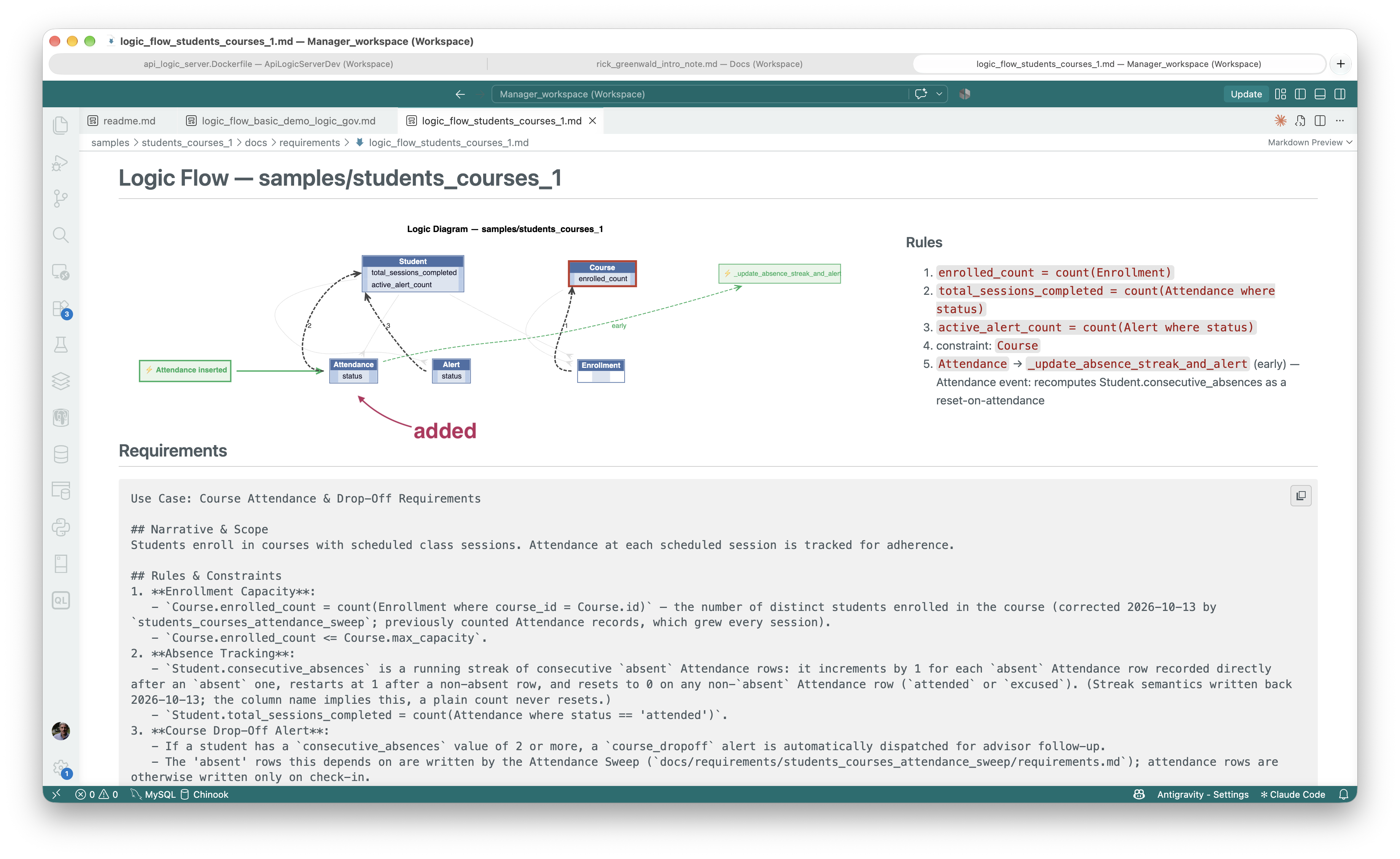
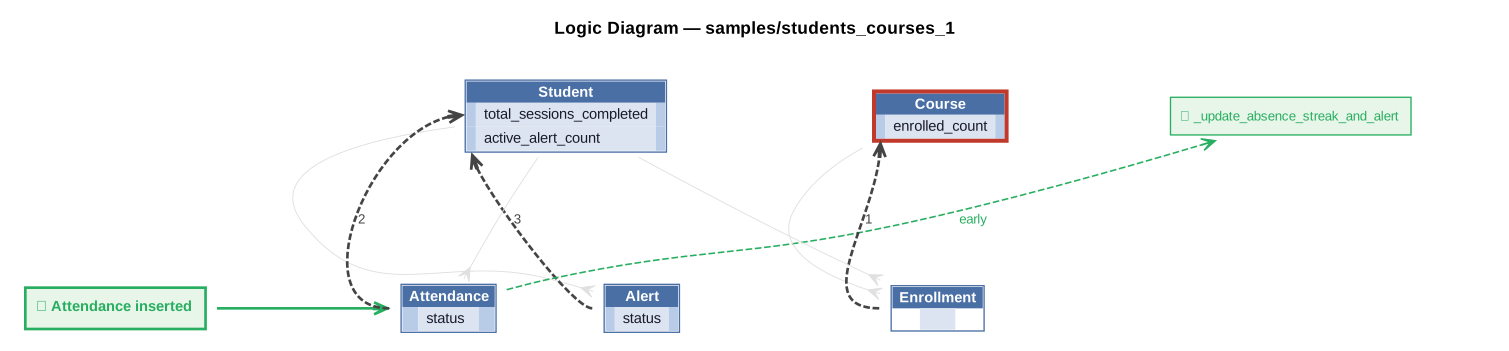
endpoint and an Enrollment table, then re-enables the already-written streak and alert
logic. The Enrollment table also fixed a second, separately-filed finding for free:
Course.enrolled_count had been counting Attendance records instead of distinct enrolled
students.
The requirement was revised in the clauses that changed (everything else is untouched):
1. Course.enrolled_count = count(Enrollment where course_id = Course.id)
2. Student.consecutive_absences is a running streak of consecutive absent Attendance rows:
   increments for each absent row directly after an absent one, restarts at 1 after a
   non-absent row, and resets to 0 on any attended or excused row.
3. The 'absent' rows are written by the Attendance Sweep; attendance rows are otherwise
   written only on check-in.
Note clause 2: the streak semantics the AI inferred from the column name were written back into the requirement, so the spec no longer depends on anyone noticing the name.
Try it
# Phase 1, from the Manager:
implement reqs students_courses

# Phase 2, on a copy of the resulting project:
cp -r samples/students_courses samples/students_courses_1
cd samples/students_courses_1
cp -r ../requirements/students_courses_attendance_sweep docs/requirements/
Then, to the assistant:
implement reqs students_courses_attendance_sweep — note it also corrects course_dropoff's
Clause 1 (enrolled_count), update that use case's files too
The note matters: the sweep requirement says the enrolled_count correction belongs to
course_dropoff, but "implement reqs students_courses_attendance_sweep" naturally limits the
assistant's attention to that set's own files. Without it, enrolled_count can be left
counting Attendance rows.