Top CIO Concerns
Six CIO Problems. One Root Cause.
Ask your AI to list the top ten CIO priorities. Six of them — governance, agentic risk, technical debt, compliance, data integrity, architecture future-proofing — are symptoms of one problem:
business logic that's scattered, untested, impossible to audit.
The root cause is a wrong turn we keep taking — translating declarative intent into procedural code.
One Root Cause
Business intent is declarative by nature. "Customer balance must not exceed credit limit." "Order total is the sum of its items." These are statements about the underlying truth of the data — the what, not the how.
Business users have long wondered why a simple requirement takes so long. CIOs have wondered why a rule change takes three sprints. The answer is the same:
Translating declarative intent into procedural code is a 40X expansion.
The intent — one clear statement — becomes hundreds of lines scattered across endpoints. Ordering dependencies nobody fully understands. Paths nobody can prove are complete. The logic is in there somewhere. But it's no longer the intent. It's obscured, under the weight of a large, fragmented codebase.
That's where governance breaks down. Miss one path and the data is silently wrong. Add a new agent, a new endpoint — neither inherits the rules. There are no rules to inherit. There is only code.
And it's a familiar problem. Developers translated intent into procedural code by hand — slow, error-prone, 40X bloat. Code generators automated the translation — same output, faster, same problems. Now AI generates it — same output, much faster, same problems, now at scale.
Each generation thought the tool was the bottleneck. It wasn't. The translation was.
The Fix
Keep the intent declarative. Make it executable.
Rules live on data — not in execution paths. They fire at the one place every transaction must pass through: the commit point. Not because a developer remembered to call them. Because there is no other path.
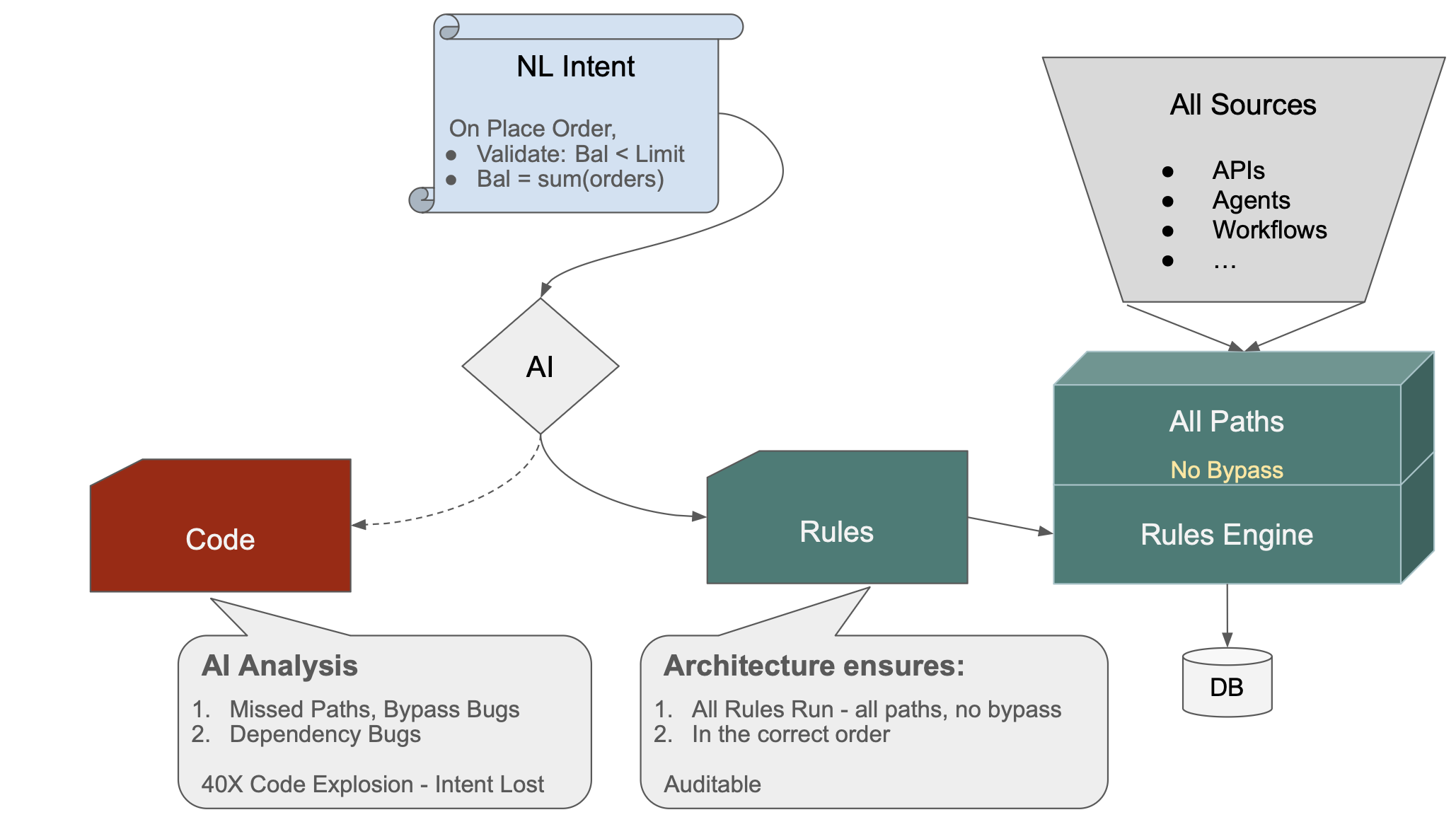
This was manageable when paths were known and finite. But AI agents create new paths dynamically — paths you cannot enumerate, test, or predict. At that point, path-based governance stops working entirely.
Every source inherits the same governance automatically — APIs, agents, workflows, Vibe-generated apps. You don't govern paths. You govern commits. The rules don't erode as the system grows.
AI's Proper Role
AI isn't the problem. We've given it the wrong job.
Relieved of procedural code generation, AI does what it's genuinely brilliant at: understanding intent and expressing it as declarations. Natural language is already declarative in spirit. "When an order is placed, check the credit limit" — that's not a path. That's a rule, and should be preserved.
The Proof
A charge allocation system — real business logic, multi-table derivations, compliance requirements — previously took four developers two years to build.
Rebuilt with declarative rules, it took a weekend.
With GenAI-Logic directing AI to generate rules instead of code, the same system takes five minutes from a business prompt.
Not because the problem changed — but because the representation did.
What the Architecture Guarantees
A fundamental claim that procedural code cannot make:
All relevant rules run, in the correct order, on every transaction.
This is the same kind of guarantee a database makes about transactions — applied to business logic. The rules engine computes dependency order from the rules themselves at startup — deterministically. The commit listener means there is no path that bypasses them. Not "we tested the paths we thought of." Guaranteed by construction.
You don't assert compliance. You produce the proof.
Rules as a Strategic Asset
Procedural code is a liability. It's opaque to everyone except the developer who wrote it. When they leave, the intent leaves with them.
Declarative rules are different in kind. The intent is retained — readable by business users, by developers, by AI. That's what makes the downstream value possible.
Enforced by construction. Rules fire at the commit point on every transaction, every path, without exception. Rules are the governance. Governance isn't a discipline you maintain. It's a property the architecture provides.
Documented by construction. Because rules are the requirements, the system generates its own tests, runs them, and produces a logic report linking scenario → rules used → execution results. Nobody writes the tests. Nobody writes the report. The audit trail is complete — readable by everyone in the organization, provable to anyone outside it.
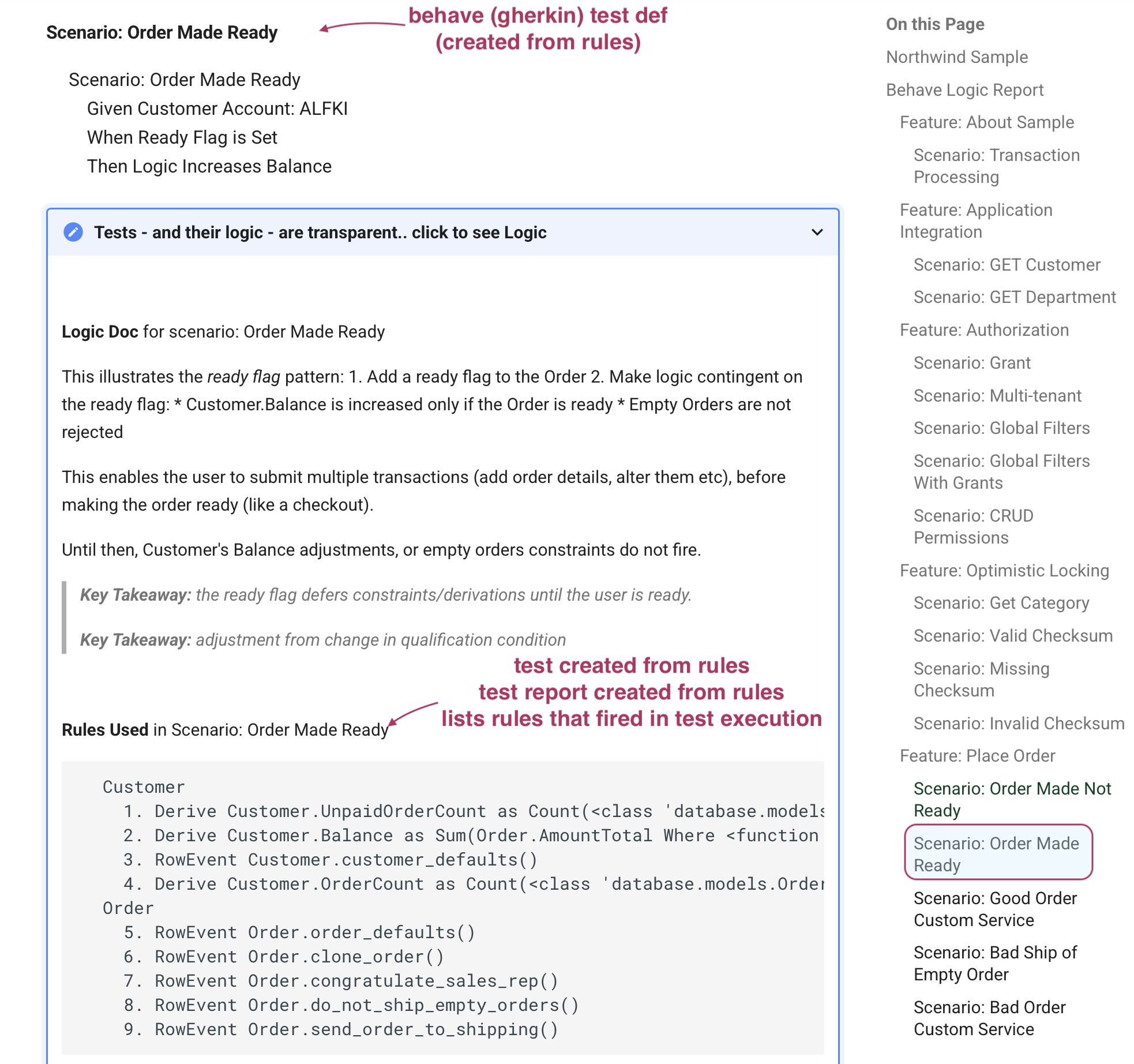
This is the deeper return on the architectural decision. You don't just govern your system. You can prove it.
Try It
This isn't a concept. It's open source you can evaluate directly — governed MCP servers, Vibe development backends, AI Rules with deterministic enforcement. Each is a working demo you can explore in a day.
[genai-logic.com]
Val Huber is co-founder of GenAI-Logic and former CTO of Versata.