AI, You're in Control
AI, You're in Control — With Just Enough Guidance
Two Old Answers to "Where Do I Start?"
Low-code studios solved onboarding with walls — a fixed palette, a proprietary format, a canvas you couldn't step outside of. That wasn't a design failure. Before AI, it was the only way to get a data model, rules, and UI captured as one coherent system: encode the knowledge in the tool itself, because there was no other way to make it legible to both the system and the person building it. Versata, and its peers, had to do this. The cost was real too — non-standard tools, logic trapped in a format your git diff can't read — but it bought something no alternative at the time could match.
AI removed the walls, and for a while that felt like the whole story. Point a general coding assistant at a domain and describe what you want — no palette, no canvas, no format to submit to. Just say it.
But a clean sheet of paper has a cost nobody prices in up front: where do I start, and what's next? Ask a frontier model to build something nontrivial with zero guidance and you'll get an answer — fast, plausible-looking, confident. Whether it's the answer that fits your actual domain is a separate question, one the blank page never forces anyone to ask.
We've written elsewhere about one sharp version of this cost: handed a typical, natural-language spec with no guidance toward rules, AI defaults to procedural, one-path code — the insert works, the update and delete silently don't (the experiment). That's not a one-off bug. It's what "no guidance" looks like when it meets a real requirement.
Two Kinds of Knowledge, Conflated
Put the studio and the blank page side by side and a pattern shows up: both are trying to hold two different kinds of knowledge in one place, and both pay for it.
There's system knowledge — the generic part, and specifically the enterprise part. How a rule should cascade through dependent tables. What a foreign key lookup should look like. A robust API shouldn't be something you have to ask for either — optimistic locking, pagination, filtering, related-data retrieval are just assumed, the same way role-based access and audit trails are assumed. None of this is specific to your business; it's what any enterprise-class system needs, regardless of domain — the same knowledge a general coding assistant has to reconstruct, unevenly, on every single project, and easy to leave out precisely because nobody asked for it by name.
And there's domain knowledge — your requirements. Your entities, your rules, your policy. The part only you know.
The studio bundled both into the tool, walls and all — which is exactly why it worked before AI could read code, and exactly why it chafed once you wanted to specify domain knowledge on your own terms. The blank page went the other way: it throws out the walls, but throws out the system knowledge with them, leaving a general model to reconstruct it fresh, from scratch, every time — with no guarantee it lands the same way twice.
Guidance, Without the Walls
Context Engineering is what happens once you stop conflating the two. Factor the system knowledge out, ship it with every project as training material — plain Python and markdown, not bolted onto a vendor's runtime — and hand the rest back to you. The result is an enterprise-aware system, not a generic one: the AI already knows business logic belongs in declarative, no-bypass rules — not scattered across handlers — already knows a lookup wants an integer foreign key, already knows role-based access and audit trails aren't optional extras, before you've typed a word. What's left for your prompt to supply is exactly the part that was always yours — the domain.
The guidance travels with the project, too. Open it in six months, hand it to a new hire, point a different AI assistant at it — the knowledge is still there, because it was never locked in a studio's format to begin with.
Two real sessions, same basic_demo project, show what this looks like from the inside:
Just enough guidance — a menu of real next steps, not a forced curriculum
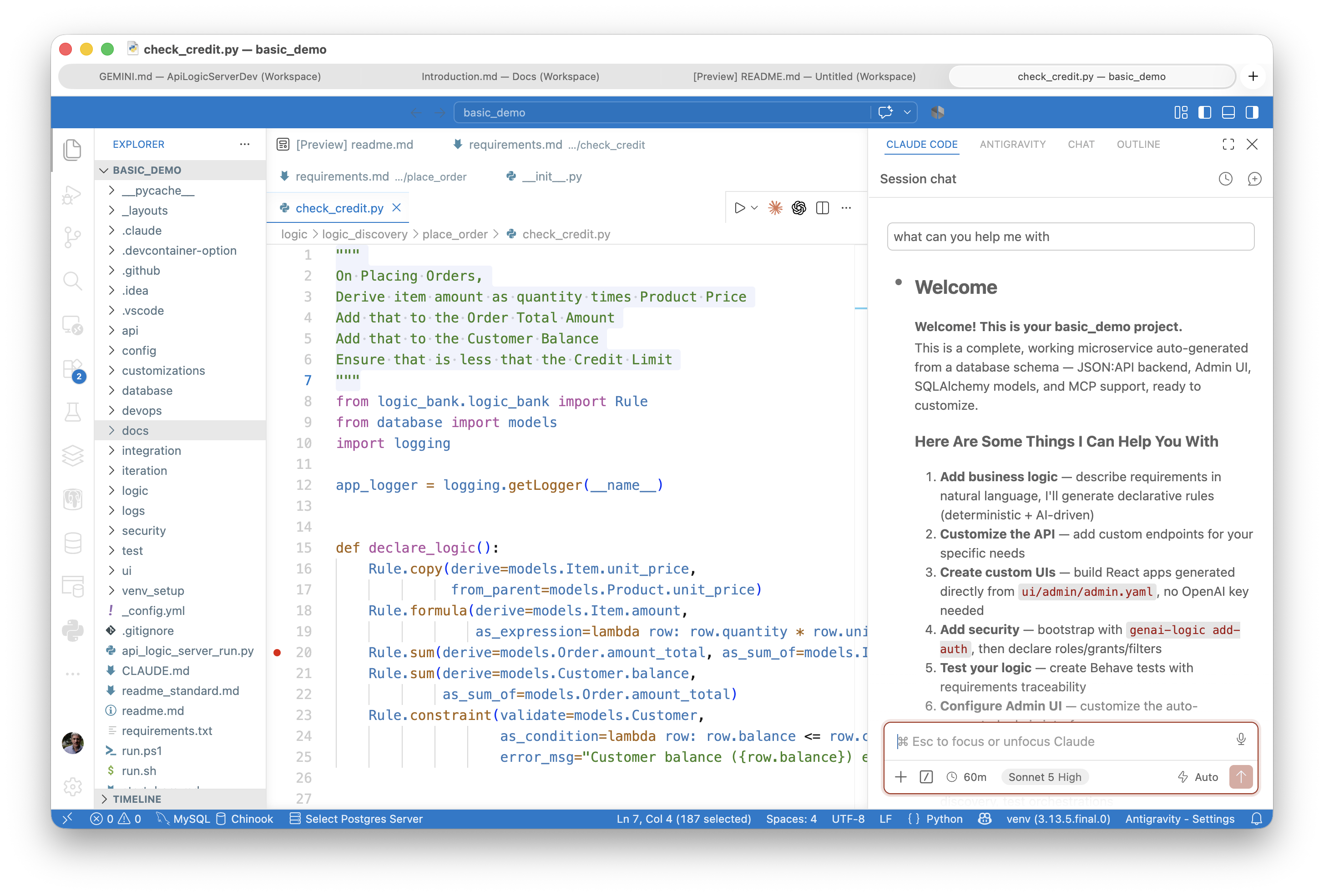
Ask "what can you help me with" and you get a menu grounded in this project — not a generic capabilities list. Nothing is off the menu. Nothing is forced either.
Product depth on tap — a real answer, not a canned one-liner, with follow-up discussion
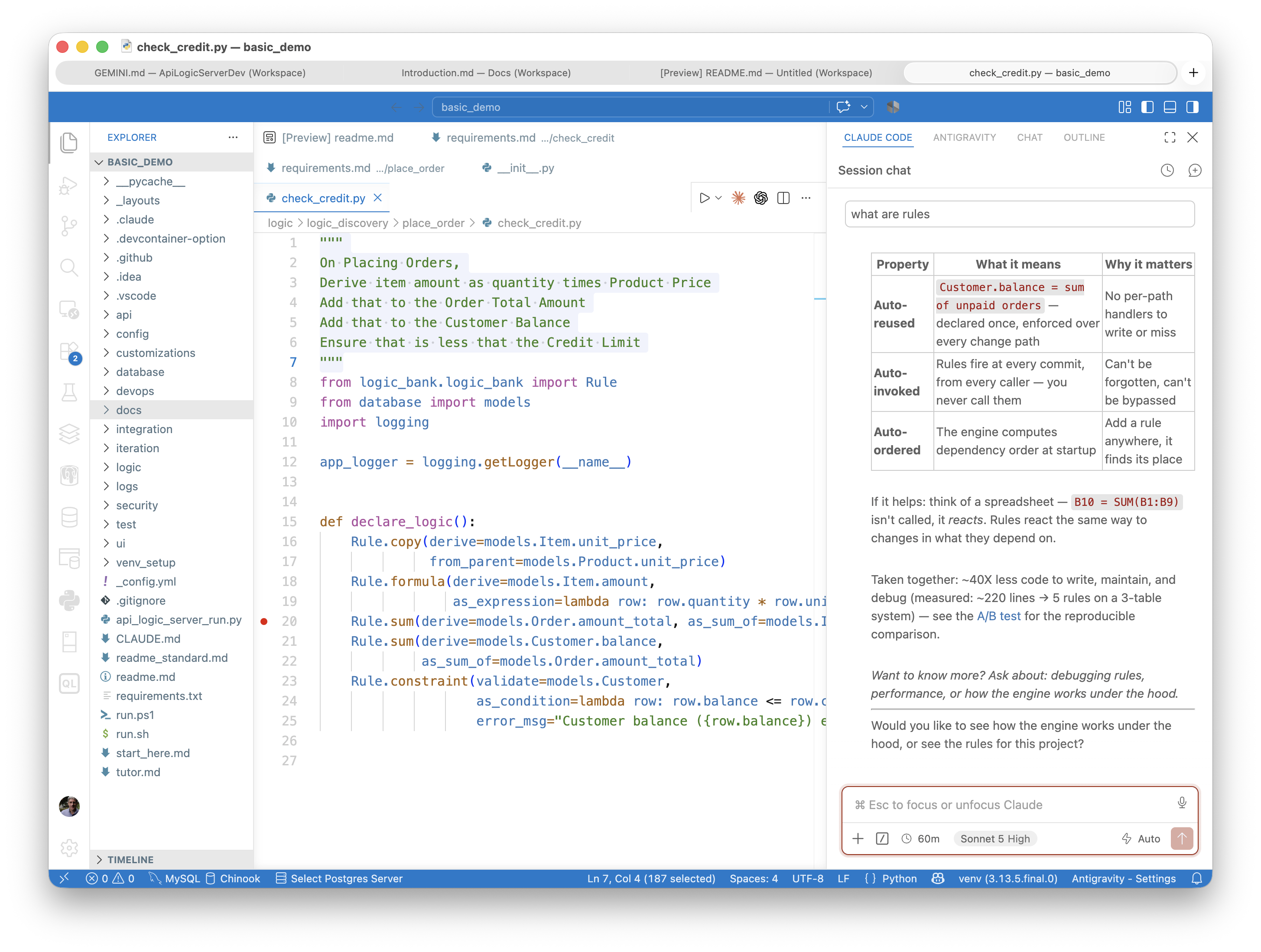
Ask "what are rules" mid-session and the AI doesn't deflect to a doc link. It explains, in the vocabulary of the project you're actually looking at, with room to keep asking.
Compare that to a studio's help system: a fixed set of screens, the same for every user, blind to what you're actually working on. And compare it to asking a generic assistant the same question with no project context: a textbook answer about "business rules" in the abstract, disconnected from the code in front of you.
Why This Doesn't Become Its Own Wall
The obvious objection: isn't "training material embedded in the project" just a studio with extra steps? A softer wall is still a wall.
The difference is what happens when the guidance doesn't fit. A studio's constraint is mechanical — the palette simply doesn't have the field you need; you're stuck until the vendor ships it. Context Engineering's guidance is something the AI reasons over, not a gate it checks against. It steers toward rules by default because rules are usually right — but "usually" isn't "always," and when a requirement is a genuine judgment call, the AI flags it and asks, or writes the deviation down for your review (ad-libs.md) rather than silently picking one path. You can always still open the file and write procedural code by hand if that's genuinely the right call. Nothing mechanically prevents it. The guidance is a strong prior, not a lock.
That's the structural difference: a wall fails by refusing you. Guidance fails, when it fails, by being wrong out loud — and it's still just Python, still just markdown, still yours to override.
Where the Knowledge Actually Lives
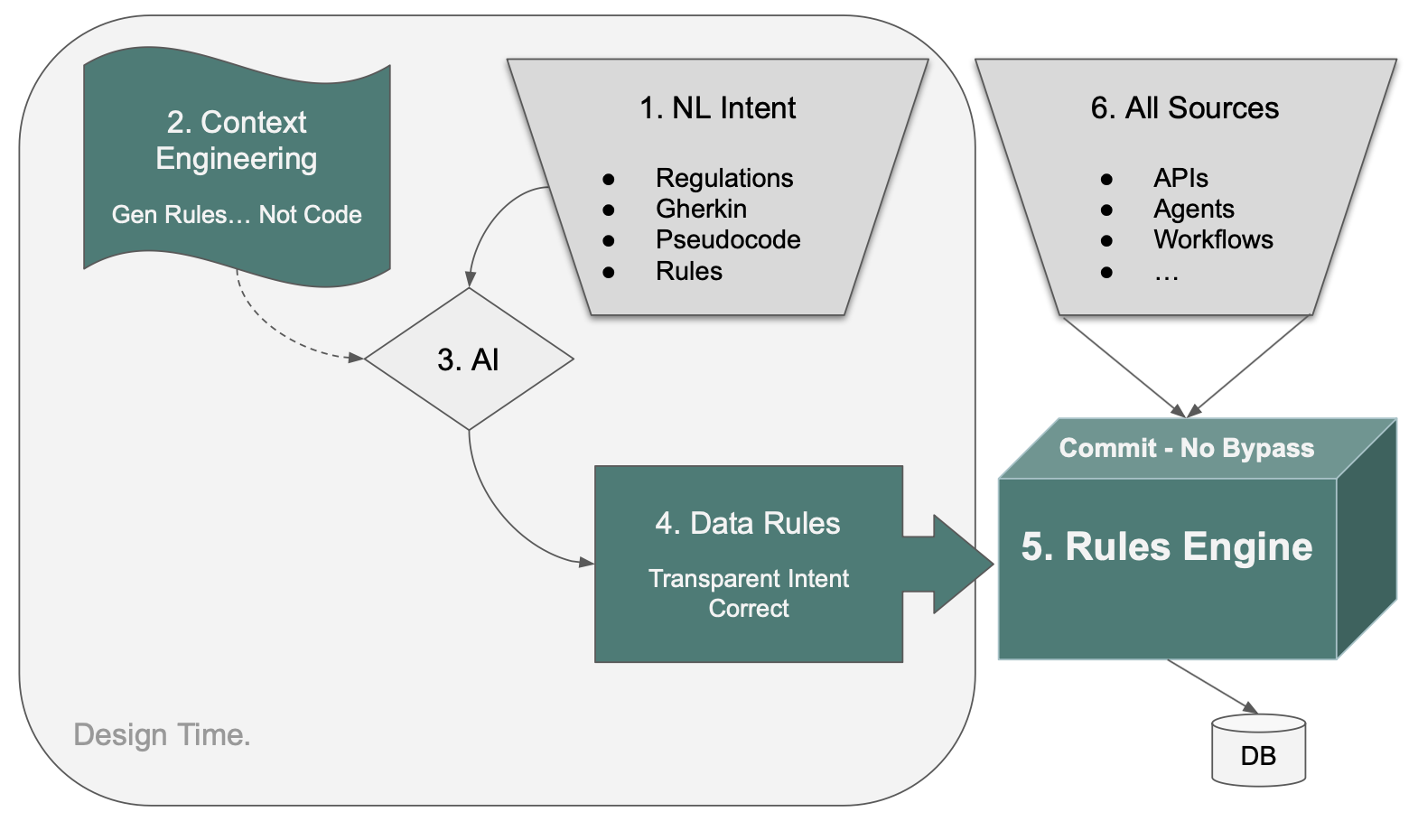
This is the same design-time funnel that turns varied requirement formats into the same governed rules (Governance Across the Portfolio) — it's also what's answering you when you ask "what can you help me with." One mechanism, two payoffs: consistent output, and a guide that actually knows the project.
Design time: Context Engineering steers generation toward rules and flags judgment calls for review.
Conversation time: the same material answers your questions, in the project's own vocabulary, whenever you ask.
Runtime: the rule engine enforces what got built, on every commit, regardless of source.
Three moments, one source of guidance — not three different tools you have to reconcile.
The Actual Claim
Not "AI is easier now." Something narrower and more useful: the tradeoff the industry has been treating as fundamental — walls or freedom — isn't fundamental. It's an artifact of where the knowledge was allowed to live. Put system knowledge in the project instead of the tool, and you get an enterprise-aware starting point with the freedom of a blank page — the guidance of a studio, none of its walls.
See also: Introduction for the full pipeline this fits into, and the native-AI experiment for what happens without this guidance at all.