Types and Ontologies
 TL;DR - Ontology Creation
You can ask AI to create an Ontology. This is a formalized meta data format useful to other tools.
It is somewhat like a schema, but includes type information. See, for example, the Employee Types Sample.
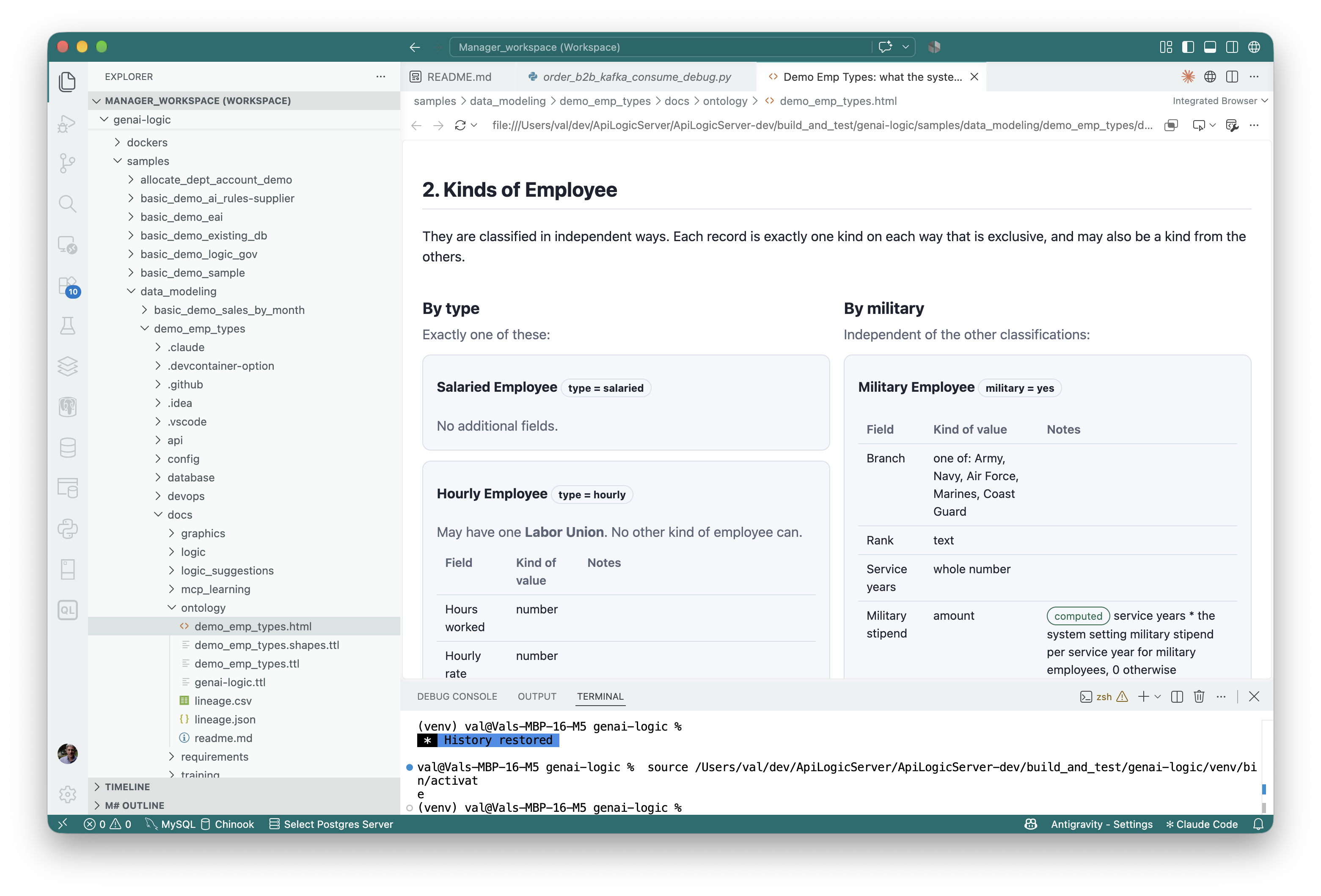
This defines and creates a familar employee type hierarchy:
// to create: implement demo_emp_types from samples/prompts/emp_types.prompt.md

System for Departments and Employees, illustrating two independent classification axes on the same entity — employment type and military status.

Departments have a name and a budget. Department.total_salary = sum of Employee.salary (all types). Department.total_salary must not exceed Department.budget. A user with the manager role may exceed the budget; other users may not.

Employees have a name, dept, and salary. Employees have a type that is one of: 'salaried', 'hourly', or 'commissioned'.

Hourly employees are employees with hours_worked (REAL) and hourly_rate (REAL). Hourly employees: salary = hours_worked * hourly_rate. Hourly employees: salary must not exceed 5000 per week. Hourly employees may be assigned to a Union (optional); only Hourly employees may have a union_id. Unions have a name and a dues_rate (REAL). Hourly employees: union_dues = hours_worked * union.dues_rate (0 if no union assigned).

Commissioned employees are employees who can have Orders; only Commissioned employees may have Orders. Each Order has an amount and a customer name. Commissioned employees: commission_total = sum of Order.amount. Commissioned employees: salary = base_salary + commission_total.

Employees may also have a military classification, independent of employment type. Military employees have a branch (TEXT: 'Army', 'Navy', 'Air Force', 'Marines', 'Coast Guard'), a rank (TEXT), and service_years (INTEGER). Military employees receive a military_stipend (REAL) = service_years * 100. Total compensation for military employees = salary + military_stipend. Total compensation for non-military employees = salary.

create logic diagram for each requirement (skip if graphviz is not available)

create tests from rules, using default names

run the tests

run the requirements traceability report

create the ontology (validate it if rdflib is available)