For Architects
 Welcome to GenAI-Logic
AI is remarkable at generating code, but it's hard to read and trust. How can you govern what you can't read?
Our core focus is to leverage AI intent capture, but direct it to create enterprise-class systems you can read, trust and maintain.
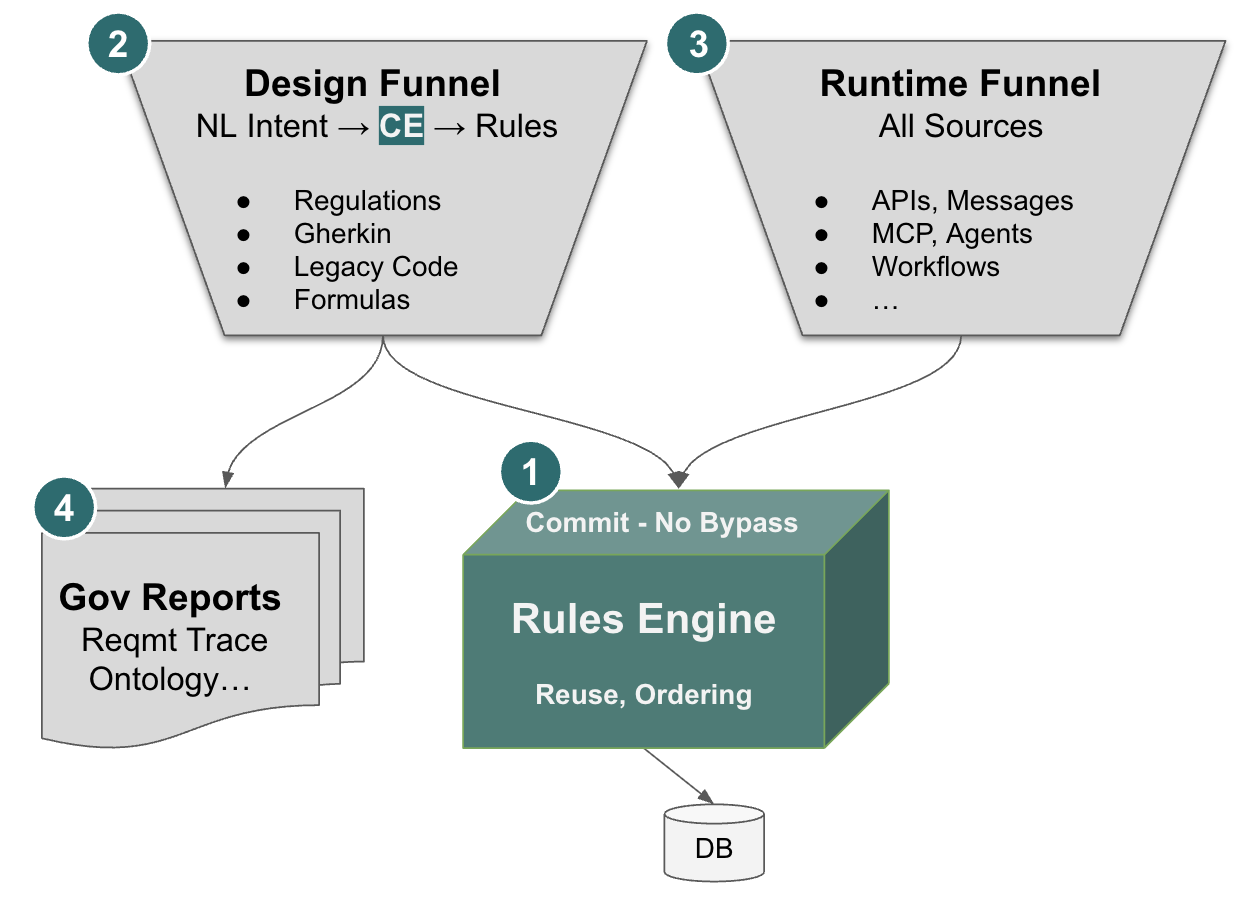
Two funnels, meeting at the rules: any form of intent becomes rules (2), every transaction source (3) is governed by them at commit (1), and the same rules drive the governance reports (4). More in Governance by Architecture.
1. Business Logic - rules not code
We provide extensive CE to direct AI to generate rules, not code:
- Read: 40X more concise, and free from dependency management complexity
- Trust: rules are not called; they are wired into a single SQLAlchemy
before_flushlistener, so they run on all transaction sources (APIs, MCP, messages, app code) and paths - no second door. Reading a rule tells you it runs, without tracing call sites. Governance by architecture, not discipline. - Maintain: change a requirement, change one rule. The engine re-derives everything that depends on it - no hunting for change paths, and no regenerating and re-reviewing procedural code.
Iterate requirements, not code: code generation - whether AI or classic - breaks down when you have to "edit the generated code": you're patching an artifact, not the thing you actually meant. Here, you describe the next requirement and get back a rule that covers every path - insert, update, delete, reassignment - not just the one you tested. When you do need code, it lives alongside the rules, not layered on top of them.
See - Declare Rules with AI
You can declare rules in an existing project as shown below. You can also declare them when creating projects - see 2. Executable Requirements.
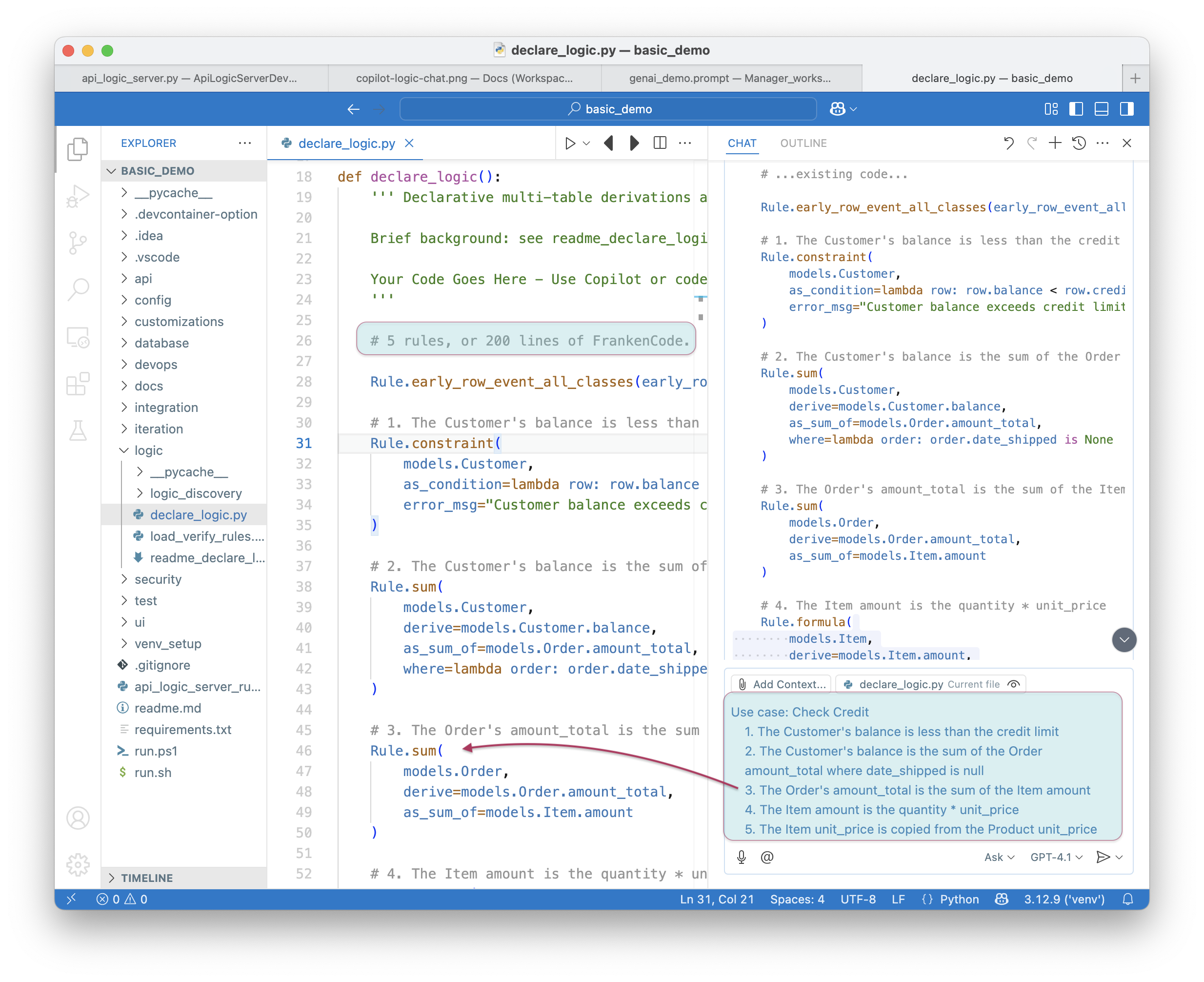
Think of a DBMS: the rules are the DDL, and the rules engine is the database server - it runs inside your service and enforces them at commit.
The engine is not RETE: it is purpose-built for transactions. It receives the actual change events, fires only the rules they affect, and maintains aggregates incrementally instead of recomputing them.
When a rule can't express it, Python events are the extension point - they run in the same transaction, integrated with the rules. Events can't silently reopen the bypass: the engine refuses to start if an event mutates a row without an explicit override.
Rules address business logic and Role Based Access Control.
The approach is proven: the same technology ran in production for decades at Wang PACE and Versata.
2. Executable Requirements
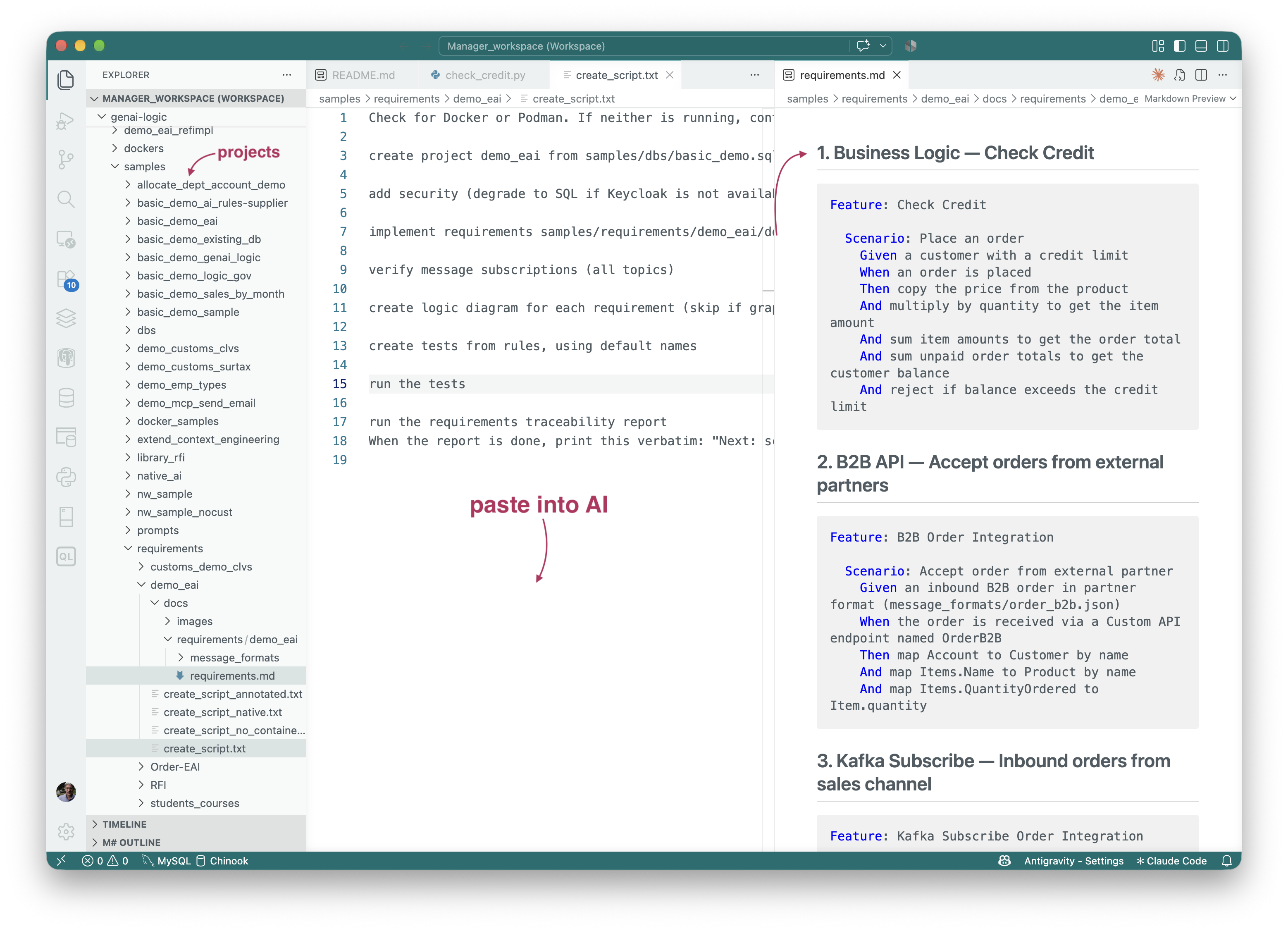
No matter how requirements are provided, rules are created. CE even enables AI to interview users to capture requirements, or process requirements extracted from legacy code (Modernization).
The output is rules even when the input reads procedurally: given the same procedural spec, native AI built the insert path only, while this pipeline produced 5 rules covering every path. Repeated across projects, the result has been rules every time.
This works particularly well with VSCode Agent Window, so Developers and Business Users can share the same tools.
See - Requirements Specification
3. Enterprise-class architecture
That same CE automates systems with rule-enabled access:
- Enterprise-class APIs: pagination, optimistic locking, filtering, sorting etc. APIs are automatically MCP enabled, so agents can invoke them with full deterministic logic enforcement.
- Message handling: declare subscribe and publish
Proof points: Customs CLVS, Surtax, Budget Allocation
4. Governance
In addition to no-bypass transaction logic runtime enforcement, the system provides review support with:
- Test creation and execution, by leveraging rules, to verify the requirements and rule execution
- Traceability reports that trace requirements to the underlying rules, and confirm their execution on tests
- AI Alerts: reports where AI proactively calls for review for inferences drawn from incomplete or vague requirements - and where there is no safe default, it stops and leaves a
FIXMErather than guessing - Logic flow diagrams and a health check (rule adoption, dependency-tracking integrity), generated from the rules
- Ontology creation makes systems available to an important class of tools, and provides terminology clarity for business users
5. Works with your other tools
Your IDE, your debugger, your git, all work normally. Rules are plain Python files, committed like everything else. Stack: Python, Flask, SQLAlchemy, Docker. Works with MySQL, Postgres, SQL Server, Oracle, SQLite. Nothing proprietary, nothing to unlearn.
Standard JSON:APIs enable the use of Vibe tools for custom UI dev.